


Across the SEA :
A Voyage full of learnings anchored for a lifetime
TEACHING PRACTICE
 |  |  |  |
|---|---|---|---|
 |  |  |  |
 |  |  |  |
 |  |  |  |

PROCEDURES OF TEACHING

TIME MANAGEMENT AND ORGANIZING ACTIVITIES

CLASSROOM MANAGEMENT

PROBLEM-SOLVING WHILE TEACHING
PROCEDURES OF TEACHING
I conducted the class according to what I had planned in my lesson plan, but I didn’t fully conform to it.
I began the class by greeting everyone as determined by the time. I was still confused until what time "Pagi" and "Siang" were, but I made sure that before I entered the room, I knew what word to use to greet them. I also taught them how to greet each other in Ilokano, my native tongue, as well as in Filipino. Like “Naimbag nga bigat” and “Magandang Umaga” both means Good morning in English translation.
After greeting them, I implemented a short game or activity to get them warmed up. I just provided basic questions and activities so that students would not feel driven or afraid to answer in class.
I presented my topic after the motivation part. However, in order for them to comprehend the basic concepts first, I defined every single word. I explained the meaning of the words "Present and Past," "Continuous," and "Tense" one by one as a basis of their knowledge, especially since they are not well-versed in the English language, which is my preferred language of teaching because I am an English Major. But, just in case they were really having difficulties understanding me, I was accompanied by my buddies who were translating what I was trying to say in class. I talked in English, and they translated it into Indonesian.
I moved on to my main topic upon defining each phrase. I talked carefully and slowly so they could understand. And I simplified each statement because, even if I have interpreters, I want them to understand it from me first. Since the ability to adjust with students is one of the skills of a teacher that should be possessed and developed all the time, because you will meet different versions of students in every classroom where you will teach.
After going over one term or bullet, I presented them a structure to use to construct a sentence out of it, as well as examples to help them grasp what I was talking about. I didn't instantly go to the other part of the topic or the next slide of my presentation; instead, I offered the structure first, followed by examples, and then, to see if they learnt anything, I'll ask them to give an example as well, and write it up front. I still guided them even though they were the ones answering in the board, and then I checked the response of the student who stepped into the spotlight by asking the other students if what he/she answered was right.
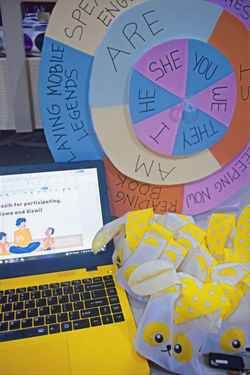
Following the structures and examples, I gave them a psychomotor and cognitive execution related to the topic. I provided the students with instructional materials to better understand the topic but in an enjoyable way.
Right after that activity, another activity was undertaken, but this time it was written down. I
assigned them the responsibility of writing 10 sentences about the topic, and after they finished, I offered them a little gesture of appreciation for participating in my class. I gave them oleh-oleh or souvenirs, which consists of chocolates, candies, and keychains from the Philippines.
After the discussion and activity implementation, I formally concluded the class and said goodbye to everyone.
TIME MANAGEMENT
AND ORGANIZING ACTIVITIES
I arrived in the classroom 5 minutes before the start of instruction to prepare my teaching materials. During the actual teaching, I made an effort to be mindful of my time, setting specific time for every part because they are all important in the teaching process and I couldn't afford to miss any of them. I ensured that I followed the directions provided on my lesson plan.
15 minutes for the Preliminary Activities, 1 hour for the Core Activities, and 15 minutes for the Generalization and Closing Activities. And for the evaluation exercises, I set them a time limit so that it wouldn't take too long.
In organizing activities, I simplified the instructions so that they would not be confused and ask questions all the time. After I gave them the directions, I did not only sit in front and wait for them to finish, but I went around the classroom to see whether they were all doing their activities, and if they had any questions, they would be able to approach me more easily because I was right next to them. When I noticed that someone was struggling to understand what they needed to accomplish, I asked him or her what was wrong, and gladly they addressed their worries, even though I sensed that they were timid and shy.
CLASSROOM MANAGEMENT
I always made sure they grasped my discussion by constantly asking them whether they understood. And if they said yes, I'd ask them a question to see if what they stated was true. Furthermore, I moved around the classroom, not just at the front to teach, but also in the middle, rear, and side-by-side, to ensure that all of the students were engaged in my class.
And, like the teacher I observed, I checked to verify if they were physically comfortable with their chairs, tables, if the room is conducive for learning, and so on, so that they could focus on my class.
PROBLEM-SOLVING
WHILE TEACHING
One of the most difficult experiences I encountered while teaching and staying at SMP Muhammadiyah 1 Kartasura was the language barrier. Given that I don’t understand and I don’t speak in Indonesian and the majority of the people there do not speak English, which is the only language we can use to communicate with each other, I was challenged.
Students as well as teachers were both hesitant to speak with me because I was a foreigner and they couldn't speak English. One of the teachers stated that they want to converse and socialize but are afraid of making mistakes and that misinterpretation will occur.
However, I assure them that making mistakes is common, and I understand that they are not well-versed and well-exposed in English because it is a foreign language for them; as long as I understand what they want to communicate, it is completely alright with me. During my stay there, I usually advise them, especially the students, to take steps to communicate in English because it will serve as their practice in learning it. It may not be perfect, but the fact that they make an effort to do so is what is important.
Because of this, I realized that differences may be odd sometimes, but it is what make things more interesting.

WE ARE DOWN TO THE HIGHLIGHT OF THIS TRIP!
FOR YOU TO BE ABLE TO EVALUATE HOW I TEACH, WHAT STRATEGIES AND APPROACHES I APPLIED, AND HOW THE STUDENTS REACTED TO MY WAY OF TEACHING THEM.
WHAT DO YOU THINK ABOUT THIS DESTINATION?